Securing the Agentic Frontier: Governance & Cost Control

Writer
The security conversation around AI agents is usually framed as a developer problem: prompts, tools, packages, APIs, and guardrails. That is too small. For enterprise leaders, agentic AI is really a governance and cost-control problem wearing a security hoodie.
If an agent can read enterprise data, invoke tools, call paid models, and act without a human clicking every button, then it is no longer just software. It is a non-human worker with a budget, a blast radius, and an audit trail. Treat it that way.
Executive Takeaway: Agents Need a Control Plane, Not Just a Prompt Policy
The old mental model was simple: users sign in, apps call APIs, finance pays cloud bills, and security reviews the risky stuff.
Agents collapse those boundaries.
| Old World | Agentic World | Governance Impact |
|---|---|---|
| Human users click through workflows | Agents can decide which tool to call next | Identity, authorization, and audit need to cover non-human actors |
| Developers choose API calls in code | Models may select tools dynamically | Tool access becomes a policy decision, not just an engineering choice |
| Costs scale with servers or licenses | Costs scale with tokens, tool calls, context, and retries | FinOps needs usage telemetry at agent, team, model, and environment level |
| Security reviews known integrations | Agents may discover or inherit new integrations | Supply chain and registry governance become critical |
| Incidents are mostly access or data events | Incidents can also be billing events | Budget controls become part of the security architecture |
Rule of thumb: if you would not give a junior employee unlimited access to production data, SaaS admin consoles, and an uncapped corporate credit card, do not give that combination to an AI agent either.
1. The New Mental Model: Agents Are Digital Workers With Corporate Cards
A good way to explain agentic risk to executives is this:
An AI agent is a digital employee that can read, reason, spend, and act. Identity defines who it is. Policy defines what it may do. FinOps defines how much it may spend. Observability proves what actually happened.
That framing matters because most enterprise mistakes happen when teams manage only one of those dimensions.
| Control Dimension | Business Question | Failure Mode If Ignored |
|---|---|---|
| Identity | Who is this agent, who owns it, and which tenant does it belong to? | Shared app registrations, unclear ownership, weak auditability |
| Authorization | What data and actions can it access? | Over-permissioned agents and confused-deputy behavior |
| Cost | How much can it consume before someone notices? | Token runaway, expensive model misuse, financial DoS |
| Lifecycle | Who reviews, promotes, pauses, and retires it? | Orphaned agents with live access |
| Supply chain | Which tools, MCP servers, connectors, and packages may it use? | Tool poisoning, malicious packages, rogue integrations |
| Monitoring | Can we reconstruct decisions and usage after the fact? | Blind incident response and unallocated AI spend |
This is why tenant administrators, security teams, platform owners, and FinOps practitioners must work from the same playbook. Agent security without cost governance is incomplete. Cost governance without identity is guesswork.
2. The Strategic Shift: From Static Apps to Dynamic Execution Paths
Traditional applications are relatively predictable. A developer writes code, the app calls known APIs, and the architecture diagram is mostly stable.
Agentic systems are different. They assemble work at runtime. A user asks a question, the model reasons over context, selects tools, calls APIs, retrieves more data, and may repeat the loop several times.
That creates a new risk pattern:
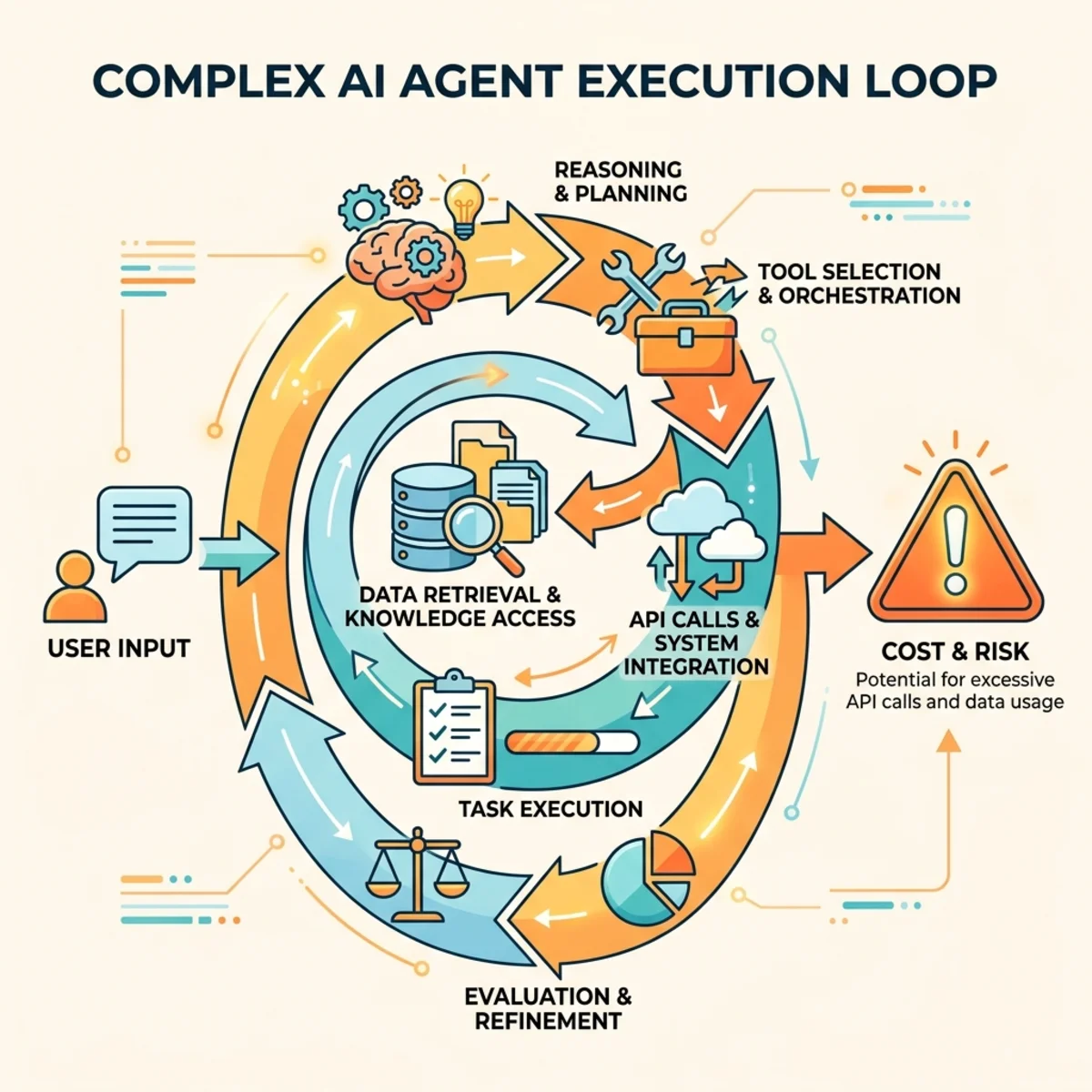
This is powerful, but it turns governance into a routing problem. The question is no longer only “Can this app access SharePoint?” It becomes:
- Which agent is asking?
- Which user is it acting for?
- Which environment is it running in?
- Which model is it allowed to use?
- Which tools can it call?
- Which data sources can be grounded into the response?
- What is the maximum cost envelope for this workflow?
The AI Gateway Mental Model
Think of your agent platform like an airport.
- Identity is the passport.
- Conditional Access and policy are border control.
- MCP servers and connectors are gates to external destinations.
- Budgets and rate limits are fuel limits.
- Logs and telemetry are the flight recorder.
An airport without gates is chaos. An agent platform without routing, approvals, and spend limits is the same problem with tokens.
3. Model Choice Is a Business Control, Not a Developer Preference
Model performance is improving fast, and the gap between proprietary and open models keeps narrowing. That is good news for innovation, but it complicates governance.
A highly capable model can generate better answers, but it can also generate bigger bills and amplify risky workflows faster. Open and self-hosted models can reduce vendor dependency and improve data locality, but they may shift the burden of safety, patching, evaluation, and abuse monitoring back to the enterprise.
| Model Strategy | Why Leaders Like It | Governance Watch-Out | Best Fit |
|---|---|---|---|
| Premium proprietary model | Strong reasoning, enterprise support, robust ecosystem | Higher unit cost, vendor dependency, regional availability | High-value workflows where quality matters more than cost |
| Smaller hosted model | Lower cost, faster response, easier scaling | May require more prompt engineering and evaluation | High-volume support, routing, classification, summarization |
| Open or self-hosted model | Portability, customization, possible data control | Enterprise owns safety, patching, monitoring, and abuse controls | Regulated or specialized workloads with mature platform teams |
| Multi-model routing | Match task value to model cost | Requires strong observability and routing policy | Mature AI platforms and FinOps-led optimization |
Opinionated guidance: do not let every agent default to the most expensive reasoning model. That is like sending every email by private jet.
Managing Heavily Guardrailed vs. Permissive Models
Consider two distinct types of models used for security workflows. On one hand, some models are so heavily guardrailed that legitimate security testing and auditing become difficult. On the other hand, more permissive models might allow for deep security-auditing workflows but increase the risk of abuse.
The management lesson here is that you need a model acceptance process that evaluates both capability and control posture.
| Evaluation Question | Why IT Leaders Should Care |
|---|---|
| Does the model block legitimate internal security testing? | Overly rigid controls can slow secure engineering and vulnerability review |
| Does the model allow high-risk dual-use generation too easily? | Overly permissive behavior can increase abuse risk |
| Can usage be logged and attributed? | FinOps and security both need traceability |
| Can the model be routed by task sensitivity? | Not every workflow deserves the same model or cost tier |
Rule of thumb: model governance is not about picking the smartest model. It is about picking the right model for the task, risk, data boundary, and budget.
Directional Cost Intuition: Token Spend Adds Up Quietly
This section is a directional planning aid, not a price quote. Always validate current rates with your cloud provider, region, model, deployment type, and contract.
Many hosted foundation models charge separately for input tokens and output tokens. AWS Bedrock publishes model-dependent pricing, supports multiple service tiers, and Cost and Usage Reports break out input, output, cache-read, and cache-write token types. Microsoft Foundry guidance similarly emphasizes estimating costs before rollout, monitoring usage, and setting alerts.
Here is the intuition:
| Scenario | Directional Pattern | Why It Matters |
|---|---|---|
| Simple FAQ bot | Small prompt, short answer | Usually predictable and cheap per interaction |
| RAG-heavy knowledge agent | Prompt includes retrieved documents | Input tokens can dominate cost |
| Reasoning-heavy analyst agent | Long chain of intermediate calls | Cost grows through retries and tool loops |
| Coding or admin agent | Tool calls, package installs, logs, long outputs | Output tokens and execution side effects matter |
| Poorly governed agent | Repeated context flooding or failed retries | Spend can spike without equivalent business value |
A quick mental calculator:
A seemingly small design choice can be expensive. If 10,000 monthly requests each carry 20,000 extra retrieved tokens, that is 200 million additional input tokens. At low-cost models this may be tolerable. At premium model rates, it can become a budget conversation very quickly.
FinOps rule of thumb: optimize the context before you optimize the model. Bloated prompts are the silent tax of agentic AI.
4. Agentic Resource Discovery: When Autonomy Becomes a Supply Chain Problem
A major architectural shift is dynamic resource discovery: agents discovering tools, connectors, skills, APIs, peers, or MCP servers at runtime.
The business value is obvious. Instead of hardcoding every integration, an agent can discover a capability and use it. The risk is equally obvious. If discovery is not governed, the agent can inherit dangerous capabilities from the wrong place.
The Model Context Protocol is often described as a standard interface for connecting AI systems to tools and data. That is useful, but it creates a new security perimeter. OWASP highlights risks such as tool poisoning, rug pull behavior, confused deputy problems, over-scoped tokens, data exfiltration through legitimate channels, and supply chain attacks. The official MCP security guidance also calls out implementation-specific risks such as confused deputy patterns.
The Shopping Mall Analogy
MCP turns your agent into a shopper walking through a mall of tools.
- A trusted internal connector is a licensed store with security checks.
- A random public package is a street vendor with no receipt.
- A poisoned tool description is a fake sign convincing the shopper to walk into the wrong door.
- A rug pull is a store that looked legitimate yesterday and changed its inventory overnight.
Your job is not to ban the mall. Your job is to control which shops are approved, what the agent can buy, and how suspicious transactions are detected.
| Integration Route | Governance Level | Recommended Control |
|---|---|---|
| Public MCP server or package | High risk | Block by default unless reviewed |
| Internal MCP registry | Medium to low risk | Require ownership, versioning, scanning, and approval |
| Enterprise connector with user-context auth | Lower risk | Enforce least privilege and user-scoped authorization |
| Service-context automation | Higher risk | Use narrowly scoped identities, compensating controls, and strong monitoring |
| Privileged admin tool | Critical risk | Require step-up approval, break-glass process, and full audit |
Open Registries and Supply Chain Attacks
Consider a scenario where an open registry of agent skills and MCP servers is flooded with malicious or poisoned entries. This is a highly practical risk pattern: open tool registries easily become supply chain attack surfaces if validation, provenance, and approval are weak.
The strategic lesson is simple: if agents can discover tools dynamically, then tool registries become infrastructure. Infrastructure needs ownership, policy, monitoring, and change control.
Rule of thumb: agents should discover capabilities from a curated marketplace, not from the open internet.
5. Real-World Threat Patterns Leaders Should Care About
There is a lot of hype about AI super-weapons. The practical risk is more boring and more dangerous: attackers exploit weak enterprise implementation patterns.
Automated Data Sifting
State-sponsored threat actors frequently use automation after initial access to sift through compromised email or document repositories for tokens, secrets, credentials, and high-value intelligence. Whether the tool is a script, a basic agentic workflow, or a more advanced LLM-assisted pipeline, the economic point is the same: automation turns a large messy mailbox into a searchable treasure map.
Once an attacker gains access to a mailbox, document store, ticketing system, or code repository, automation makes triage fast. Agents can sift through unstructured text to find API keys, OAuth tokens, credentials, architecture diagrams, customer data, and executive communications.
Governance implication: data access is the blast radius. If an agent, user, or compromised identity can read too much, automation makes the breach more valuable.
AI Supply Chain Poisoning
Agents that install packages, call public tools, or consume external registries inherit software supply chain risk. This is not theoretical. MCP security guidance and OWASP both warn about malicious servers, poisoned tool metadata, over-scoped authorization, and data exfiltration paths.
Governance implication: treat agent tools like production dependencies. Require provenance, review, version pinning, private registries, and runtime isolation.
Financial Denial of Service
A weakly protected AI endpoint can be abused not only for data access but also for spend generation. Attackers do not need to steal data to hurt you. They can force repeated expensive calls, inflate context windows, trigger retry storms, or route traffic to premium models.
Governance implication: budgets, quotas, rate limits, anomaly detection, and model routing are security controls.
In a known directional example, an exposed cloud/AI credential resulted in tens of thousands of dollars of billing impact within days. The important lesson remains: leaked AI infrastructure credentials can create immediate fiscal damage, not just data exposure.
Context Flooding
Context flooding is the practice of overwhelming an agent with massive, noisy, or adversarial input. It can degrade response quality, bury malicious instructions, increase token consumption, and make guardrail inspection harder.
| Attack Goal | Cost Impact | Governance Control |
|---|---|---|
| Exhaust token budget | High input-token usage | Per-request token caps and content truncation |
| Hide malicious instruction | Larger inspection surface | Prompt-injection filters and tool-call policy checks |
| Trigger retries | Multiplicative usage | Retry budgets and circuit breakers |
| Force premium model routing | Higher unit cost | Policy-based model routing and fallback rules |
| Pollute logs or RAG stores | Long-term quality degradation | Data validation and source trust scoring |
Rule of thumb: every agent needs a maximum context budget, just like every cloud workload needs a maximum instance size.
6. The Vibe Coding Trap: Great for Demos, Dangerous for Production
“Vibe coding” is amazing for prototypes. It compresses the distance between idea and demo. But production systems need boring controls.
The classic failure pattern is simple:
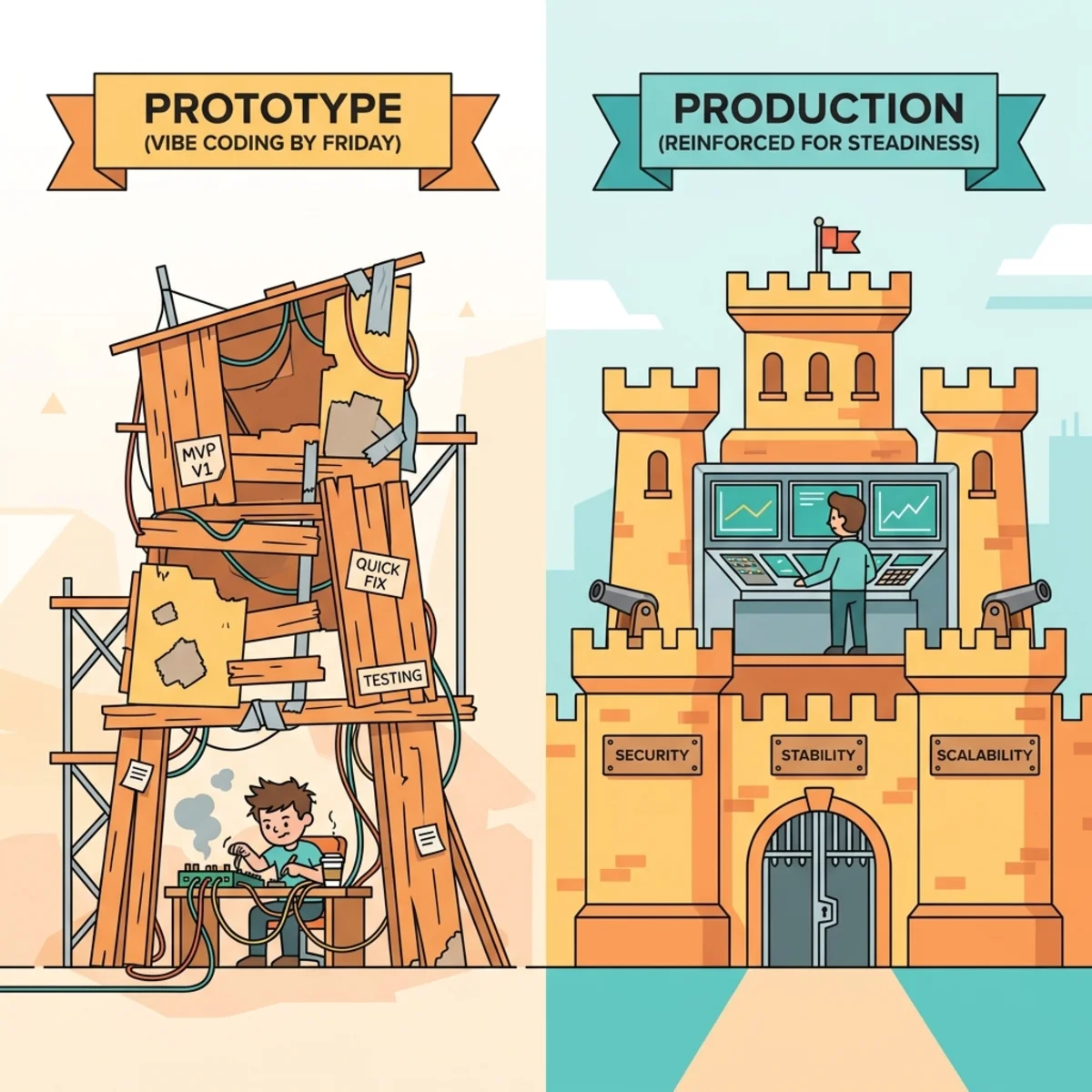
For tenant administrators and platform teams, this is not a developer-shaming issue. It is a platform-design issue. If the easiest path is insecure, people and agents will choose it.
| Prototype Shortcut | Production Replacement | Why It Matters |
|---|---|---|
| Static API key in code | OAuth, managed identity, workload federation, or brokered token flow | Reduces secret exposure and improves revocation |
| Broad service principal | Dedicated agent identity with least privilege | Improves auditability and blast-radius control |
| Public package install at runtime | Approved internal package feed | Reduces supply chain risk |
| Direct tool execution | Gateway-mediated tool invocation | Enables policy checks and logging |
| No cost cap | Budget, quota, and alert policy | Prevents runaway spend |
Opinionated guidance: do not ask every team to become an identity expert. Build a golden path where secure authentication is the default scaffold.
7. Identity Governance: From Anonymous Automation to Governed Agents
Identity is the foundation. If you cannot answer “which agent did this?” you do not have enterprise governance.
Microsoft Entra Agent ID is designed to help organizations manage, govern, and protect AI agent identities using the Microsoft Entra identity and network access control plane. Microsoft documentation describes concepts such as agent identities, blueprints, owners and sponsors, Conditional Access for agents, Identity Protection for agents, and agent lifecycle governance.
The important strategic shift is this: agents should not disappear behind shared service principals or generic app registrations. They need named, owned, governed identities.
The Blueprint Mental Model
Think of an agent identity blueprint as a job description plus an access contract.
It should answer:
- What is this agent for?
- Who owns it?
- Which environment is it allowed to run in?
- Which authentication flows are allowed?
- Which permissions can it request?
- Which policies apply before it can access data?
- When should it be reviewed or retired?
| Identity Pattern | Works for Prototype? | Works for Enterprise? | Why |
|---|---|---|---|
| Shared account | Yes | No | Bad audit trail and risky credential handling |
| Generic app registration | Yes | Sometimes | Better than shared accounts, but ownership and lifecycle can drift |
| Service principal per agent | Yes | Better | More traceable, but still needs governance metadata and review |
| Governed agent identity | Yes | Yes | Best fit for ownership, policy, lifecycle, and audit |
Practical Admin Roles and Responsibilities
| Role | Primary Concern | Agent Governance Responsibility |
|---|---|---|
| Tenant administrator | Enterprise control plane | Define identity, environment, and tenant-wide policies |
| Security architect | Risk reduction | Define least privilege, Conditional Access, monitoring, and incident response |
| FinOps practitioner | Spend accountability | Attribute usage, define budgets, detect anomalies, and optimize model routing |
| Platform engineering | Golden path | Provide approved templates, gateways, registries, and deployment pipelines |
| Business owner | Value realization | Confirm use case, data need, success metrics, and acceptable risk |
| Agent sponsor or owner | Accountability | Approve access, review logs, manage lifecycle, and retire unused agents |
Rule of thumb: every production agent needs an owner, a sponsor, a budget, a data classification, and a retirement plan.
Cross-Cloud and Vendor-Agnostic Identity Direction
Beyond a single ecosystem, we are seeing a broader movement toward cross-platform identity for autonomous workloads, including GCP Agent Identity, AWS-oriented variants, AAuth, and SPIFFE/SPIRE. We frame these as directional governance approaches, acknowledging that not all vendors expose identical, mature agent-identity features today.
| Approach | Strategic Idea | Governance Value |
|---|---|---|
| Microsoft Entra Agent ID | Give agents first-class identities, ownership, lifecycle, and policy controls | Strong fit for Microsoft-centric tenants and Microsoft 365 workflows |
| GCP or AWS agent/workload identity patterns | Use cloud-native identity primitives for non-human workloads | Reduces static secrets and improves cloud-specific auditability |
| AAuth-style agent authorization standards | Define common authorization expectations for autonomous agents | Helps avoid every platform inventing a different trust model |
| SPIFFE / SPIRE | Issue cryptographically verifiable workload identities across dynamic infrastructure | Useful mental model for short-lived, portable, non-human identities |
Rule of thumb: do not wait for perfect cross-cloud standardization before governing agents. Start with clear ownership, short-lived credentials, least privilege, and auditable access in every platform you use.
Platform Scope Caveat: Foundry, Copilot Studio, and Desktop Agents
While various agent orchestration platforms exist, tools like Copilot Studio and Azure AI Foundry provide clear public governance and cost-management documentation. Desktop-bound agent governance contexts also require attention, though enterprise adoption generally relies on platforms with established and detailed product guidance.
8. Cost Governance: The Missing Chapter in AI Security
AI spend is different from traditional cloud spend. Compute costs are visible because you deploy infrastructure. Token costs are sneakier because every conversation, tool loop, retrieval call, and retry can create a charge.
Microsoft Foundry cost guidance recommends estimating expenses before deployment, validating cost plans before rollout, monitoring usage, and setting alerts with Microsoft Cost Management. It also notes that Foundry may involve several optional Azure services rather than one simple pricing calculator line item. For provisioned throughput, Microsoft explains that Provisioned Throughput Units are billed on deployed capacity rather than consumed tokens, which means idle capacity can still cost money.
AWS Bedrock similarly publishes pricing by model and modality. Its cost and usage documentation explains that Bedrock cost reconciliation may require accounting for input, output, cache read, and cache write token types, service tiers, and cross-region inference.
Pay-As-You-Go vs. Provisioned Capacity
| Payment Model | How It Feels | Best For | Main Risk |
|---|---|---|---|
| Pay-as-you-go tokens | Taxi meter | Pilots, variable demand, uncertain adoption | Surprise bills from runaway usage |
| Provisioned throughput or reserved capacity | Leasing a bus | Predictable production volume | Paying for idle capacity |
| Batch processing | Bulk shipping | Offline summarization, nightly enrichment, back-office workloads | Slower turnaround may not fit interactive use |
| Model routing | Traffic control | Mixed workloads with different value tiers | Requires quality evaluation and telemetry |
Directional Planning Example
This is a directional planning aid, not a price quote.
Imagine an internal support agent:
- 2,000 employees use it monthly.
- Each employee asks 20 questions.
- That is 40,000 requests per month.
- Each request includes 6,000 input tokens after retrieval and produces 800 output tokens.
That means approximately:
- 240 million input tokens per month.
- 32 million output tokens per month.
- Plus search, storage, monitoring, and orchestration costs.
Now imagine the same agent retrieves 20,000 input tokens per request because the RAG pipeline is sloppy. Input volume jumps to 800 million tokens. Nothing changed in the user experience. The bill did.
FinOps rule of thumb: track cost per successful business outcome, not just cost per token. A cheap model that fails and retries five times may be more expensive than a better model that succeeds once.
9. Platform Routing: The Governance Lever Most Teams Underuse
The most mature organizations will not let every agent call every model directly. They will route requests through a governed AI gateway or platform layer.
A routing layer can make policy decisions before money is spent and before data leaves a boundary.
| Routing Decision | Example Policy |
|---|---|
| Model selection | Use small model for classification, premium model for legal or executive synthesis |
| Data boundary | Block confidential data from non-approved models or regions |
| Token budget | Reject or summarize inputs above the context cap |
| Tool authorization | Allow read-only tools by default, require approval for write actions |
| User context | Prefer user-delegated access for data retrieval |
| Cost allocation | Tag every call by agent, business unit, environment, and project |
| Incident response | Disable one agent or tool without shutting down the whole platform |
A Simple Routing Strategy
| Workload Type | Suggested Default | Escalation Path |
|---|---|---|
| Classification, routing, extraction | Small or mid-tier model | Escalate only on low confidence |
| Enterprise search answer | Mid-tier model with curated retrieval | Escalate for complex synthesis |
| Executive briefing or legal-risk summary | Premium model with strict logging | Human review before action |
| Code generation | Isolated sandbox and dependency controls | Security review before merge |
| Administrative action | Tool gateway with approval | Step-up auth for sensitive operations |
Opinionated guidance: the model choice should be made by policy and business value, not by whichever SDK sample a team copied first.
10. Copilot Studio and Power Platform Governance: Guardrails Beat Lockdowns
Microsoft Copilot Studio governance is closely tied to Power Platform governance. Microsoft documentation describes controls such as data policies, environment routing, audit logs in Microsoft Purview and Microsoft Sentinel, maker warnings, user authentication options, and security status signals for agents.
The practical lesson: do not choose between chaos and lockdown. Use zones.
Governance Zones for Safe Rollout
| Zone | Purpose | Controls | Who Gets Access |
|---|---|---|---|
| Green: Personal productivity | Safe experimentation | Limited connectors, no sensitive tools, low budgets | Broad maker community |
| Yellow: Department solutions | Business pilots | Approved data sources, DLP policies, review workflow, moderate budgets | Trained makers and business teams |
| Red: Production and regulated | Critical agents | Managed environments, ALM pipeline, strict DLP, monitoring, approvals, runbooks | Platform team and approved owners |
This model lets innovation continue without handing every maker a production keycard.
Safe Rollout Checklist
- Inventory current agents and automations. Identify classic app registrations, service principals, Copilot Studio agents, Foundry projects, and third-party agents.
- Classify use cases by risk and value. Internal FAQ is not the same as payroll, security operations, or customer-facing advice.
- Define environment zones. Separate experimentation, UAT, and production.
- Apply DLP and connector policies. Restrict which knowledge sources, tools, connectors, and HTTP actions are available in each zone.
- Require identity ownership. Every production agent needs an accountable owner and sponsor.
- Set spend guardrails. Budgets, alerts, rate limits, token caps, and cost allocation tags are mandatory.
- Route through approved gateways. Do not allow direct unmanaged model and tool calls for production agents.
- Monitor behavior, not just availability. Track tool calls, retrieval volume, token spikes, failed attempts, and unusual users.
- Review and retire. Agents need lifecycle reviews just like apps, groups, and privileged access.
- Run tabletop exercises. Practice what happens when an agent leaks data, triggers spend, or invokes a dangerous tool.
11. RAG for Threat Intelligence: Useful, But Not Magic
Retrieval-Augmented Generation can help defenders make sense of messy threat data, but it is not a universal answer button.
Corporate PDFs are relatively clean. Incident logs, ransomware dumps, dark web text, pasted console output, and adversarial payloads are not. They are noisy, duplicated, malformed, and often intentionally hostile.
| Data Type | RAG Challenge | Better Defensive Architecture |
|---|---|---|
| Structured corporate docs | Clean chunks and predictable metadata | Standard vector search with access trimming |
| Security logs | High volume, repeated patterns, timestamps matter | Hybrid keyword and vector retrieval with time filters |
| Breach dumps | Dirty text, secrets, duplicates, toxic content | Pre-processing, classification, DLP, and controlled enrichment |
| Incident timelines | Relationships matter more than paragraphs | Graph-assisted retrieval and entity resolution |
| Adversarial payloads | Inputs may attack the agent itself | Sandbox, strict rendering, guardrails, and no blind tool execution |
Rule of thumb: the messier the data, the more you need pipelines, provenance, and retrieval discipline. Do not dump the internet into a vector store and call it threat intelligence.
12. CTI for the Agentic Workspace: Defend Like You Expect Abuse
A modern threat-intelligence perspective is important because agentic AI fundamentally changes the defender’s job. Specifically, defenders need to use Practical AI for Threat Intelligence Leveraging Agentic Workflows to understand and counter agentic abuse. Waiting for a CVE or a clean indicator of compromise is too slow.
Defenders should actively discover how attackers are probing agent systems:
- Run controlled honeypots for fake MCP servers, fake AI endpoints, and bait credentials.
- Capture real adversarial prompts and tool-abuse attempts.
- Monitor for unusual token-volume spikes and repeated failed tool calls.
- Track suspicious package names and registry changes.
- Map attack patterns to MITRE ATT&CK where possible, but do not wait for formal taxonomy before acting.
The goal is to build an early-warning system for agentic abuse.
| Signal | What It Might Mean | Action |
|---|---|---|
| Sudden token spike | Context flooding or runaway workflow | Trigger circuit breaker and inspect prompts |
| New tool added to agent | Supply chain or change-control risk | Require approval and provenance check |
| Repeated denied tool calls | Prompt injection or misconfigured policy | Alert owner and security team |
| High output volume | Data exfiltration pattern or bad prompt design | Review response content and logging |
| Cost anomaly by agent | Abuse, retry loop, or bad routing | Freeze budget or downgrade model route |
13. The Board-Level Message: Governance Is How AI Scales
Agentic AI will not be held back by lack of demos. Demos are easy. Scaling safely is hard.
The organizations that win will not be the ones with the most agents. They will be the ones with the best control plane:
- Clear ownership.
- Strong identity.
- Practical environment strategy.
- Approved tool registries.
- Model routing by business value.
- Token and budget guardrails.
- Auditability across agent, user, data, and action.
- Continuous threat intelligence.
Here is the simplest leadership question to ask before approving any production agent:
If this agent makes a mistake, spends too much, or touches the wrong data, can we identify who owns it, stop it quickly, explain what happened, and prevent the next one?
If the answer is no, the agent is not production-ready. It is still a demo with a credit card.
Quick Decision Guide
| If You Are… | Start Here | First 30-Day Outcome |
|---|---|---|
| CIO or CTO | Define agent governance as an enterprise platform capability | Executive policy for identity, cost, and risk ownership |
| CISO | Map agent attack paths to identity, data, and tool controls | Agent threat model and monitoring requirements |
| FinOps Lead | Build AI cost allocation and anomaly detection | Cost by agent, team, model, and environment |
| Tenant Admin | Inventory agents and enforce environment strategy | Controlled maker zones and DLP baseline |
| Platform Engineering | Build the golden path | Approved templates, gateways, package feeds, and deployment pipeline |
| Business Owner | Define value and acceptable risk | Use case scorecard with success metrics and budget envelope |
Key Takeaways
- Agents are not just applications. They are digital workers with identities, permissions, tools, and budgets.
- The biggest risks are often implementation failures: over-permissioned identities, unmanaged tools, sloppy RAG, and uncapped token usage.
- Cost controls are security controls. Token limits, budgets, routing, and anomaly detection reduce both spend and abuse.
- MCP and tool ecosystems need supply chain governance. Use curated registries, provenance, sandboxing, and approval workflows.
- Microsoft Entra Agent ID, Microsoft Foundry cost controls, Copilot Studio governance, and Power Platform policies are pieces of a broader enterprise control plane, not isolated features.
- The safest rollout model is zoned: experiment broadly, pilot carefully, and lock down production.
Validation Notes and Sources
Core claims were validated against the following public sources as of 2026-07-06:
- Microsoft Learn: Microsoft Entra Agent ID documentation, covering agent identities, blueprints, lifecycle governance, Conditional Access, Identity Protection, and related concepts: https://learn.microsoft.com/en-us/entra/agent-id/
- Microsoft Learn: Agent user accounts in Microsoft Entra Agent ID, including the relationship between agent identities, blueprints, and specialized user identity scenarios: https://learn.microsoft.com/en-us/entra/agent-id/agent-users
- Microsoft Learn: Copilot Studio security and governance controls, including data policies, audit logs, environment routing, maker warnings, and authentication options: https://learn.microsoft.com/en-us/microsoft-copilot-studio/security-and-governance
- Microsoft Learn: Plan and manage costs for Microsoft Foundry, including cost estimation, monitoring, RBAC, alerts, and the fact that Foundry costs can span multiple Azure services: https://learn.microsoft.com/en-us/azure/foundry/concepts/manage-costs
- Microsoft Learn: Provisioned throughput billing for Microsoft Foundry, including hourly billing based on deployed PTU capacity rather than token consumption: https://learn.microsoft.com/en-us/azure/foundry/openai/concepts/provisioned-throughput-billing
- AWS: Amazon Bedrock pricing, including model-dependent pricing and service tiers: https://aws.amazon.com/bedrock/pricing/
- AWS: Understanding Amazon Bedrock Cost and Usage Report data, including input, output, cache-read, cache-write token types, service tiers, and cross-region inference considerations: https://docs.aws.amazon.com/bedrock/latest/userguide/cost-mgmt-understanding-cur-data.html
- Model Context Protocol: Security best practices, including OAuth-related risks and confused deputy considerations: https://modelcontextprotocol.io/docs/tutorials/security/security_best_practices
- OWASP Cheat Sheet Series: MCP Security Cheat Sheet, including tool poisoning, rug pull attacks, confused deputy behavior, over-scoped tokens, and supply chain risks: https://cheatsheetseries.owasp.org/cheatsheets/MCP_Security_Cheat_Sheet.html
Read next