From Vibe Coding to Agentic Engineering: How to Actually Build with AI

Writer
Quiz available
Take a quick quiz for this article.
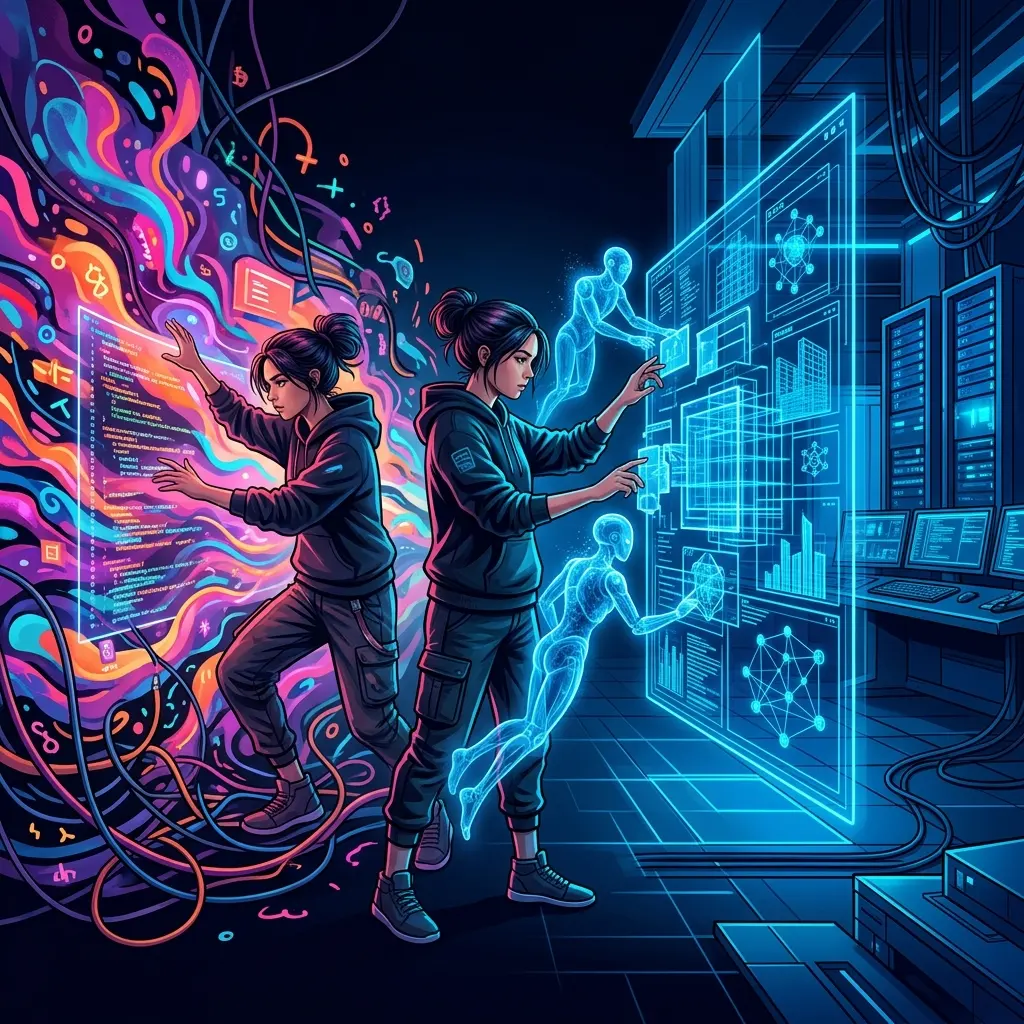
If you have built software with AI, you likely know the exact feeling: You are 200 prompts deep into what was supposed to be a two-hour project. It has now been two days. You fix one bug, and two more appear. The app is breaking, and because you didn’t actually write the code, you have no idea why.
You might think you’ve run into a tooling limitation or just hit a string of bad luck. But you haven’t. You’ve hit the ceiling of Vibe Coding.
Almost everyone hits this ceiling eventually. But the industry has already figured out what comes next, and once you understand it, that ceiling disappears. Here is why your AI projects are breaking, and how the shift to Agentic Engineering changes everything.
The Problem: The Vibe Coding Ceiling
The symptoms of hitting the “Vibe Coding Ceiling” are unmistakable: cascading, untraceable breaks. You fix a typo in the CSS, and suddenly the database connection fails.
The root cause isn’t bad luck—it’s structural. When you fire off prompts without a plan, you are injecting code you don’t fully understand. This technical debt quietly compounds until the project effectively freezes. The symptom is not a tool problem; it’s an architectural one.
The History & Impact of “Vibe Coding”
The term “Vibe Coding” was coined by Andrej Karpathy in early 2025. It defined a new era where developers could describe what they wanted, let AI build it, and iterate simply by “feeling” the results, without needing deep technical training.
Initially, it was an undeniable success. By mid-2025, approximately 25% of Y Combinator’s batch featured codebases that were 95% AI-generated, allowing founders to ship in days instead of months.
The Warning Sign: Success was short-lived for those who didn’t evolve. According to a Stack Overflow survey of 49,000 developers, trust in AI-generated code plummeted from 40% to 29% in a single year.
This drop is the natural result of discovering that code built purely on “vibes” isn’t structurally sound enough to survive real-world scaling or complex feature additions.
Enter Agentic Engineering
To solve the cycle of breaking apps, we must move past describing and start defining. Karpathy identifies the necessary evolution as Agentic Engineering.
This shift requires two mental adjustments:
- Agentic: Acknowledging that you are not writing code 99% of the time. Instead, your primary role is directing the agents that do.
- Engineering: Recognizing that directing AI is a rigorous, real skill with depth—something you can systematically improve.
The single most important word here is directing. The core mindset shift is moving from describing to defining. You must work forwards from a clear picture, rather than backward from whatever the AI happens to output.
The “Prompter” vs. The “Director”
The difference between a vibe coder and an agentic engineer is the difference between asking for a result and directing a build.

| Role | Approach | Outcome |
|---|---|---|
| The Prompter (Vibe Coder) | Asks for a 'user dashboard' and hopes for the best. | Brittle & Untraceable |
| The Director (Agentic Engineer) | Specifies exact metrics, data sources (e.g., 30s update freq), and UI states. | Robust & Scalable |
The 3 Habits of an Agentic Engineer
Agentic engineering is a thinking skill, not just a coding skill. Transitioning to this faster, more reliable workflow requires no new tools—it simply requires adopting three foundational habits:
1. Define the Output Before Opening the Tool
Precision starts before you type a single prompt. Answer what success looks like for the user in exactly two sentences. This forced clarity makes your prompts 10x more precise and prevents the AI from making wild assumptions about your intent.
2. Give the AI One Job at a Time
Vibe coders consistently try to build entire applications in a single, massive prompt. Agentic engineers do the opposite: they break the architecture down into small, highly isolated steps:
- Phase 1: Build the login flow.
- Phase 2: Build the isolated dashboard layout.
- Phase 3: Connect the dashboard to the real data source.
By keeping the steps granular, you maintain complete control over the application’s state and can pinpoint exactly where a failure occurred.
3. Review Before Moving On
This is the habit that eliminates the “something broke and I don’t know where” problem. You must systematically test and verify what the AI just built before you prompt it to do the next thing. Confirm the foundation is solid before you ask the AI to build the next floor.
Conclusion: The Future Belongs to the Clear Thinkers
Vibe coding wasn’t wrong; it was just step one. Agentic engineering is the evolution. By defining what “right” looks like and strictly directing the AI to get there, you stop hoping for good code and start engineering it.
The developers and founders who build the most interesting, robust products in the coming years will not necessarily be the best traditional coders. They will be the clearest thinkers—the people who can envision exactly what they want and direct AI with surgical precision to execute it.
Read next