Beyond GraphRAG: Building Graph-Powered AI Systems

Writer
A dense network visualization is hard to resist. Nodes glow, relationships span the screen, and hidden structure appears to emerge from chaos. In the generative AI era, that visual appeal can quickly become an architectural decision: deploy GraphRAG, extract a knowledge graph from every document, or replace a relational backend with a graph database.
That is often where the trouble starts.
A graph is not useful because it looks connected. It is useful when its nodes have stable identities, its relationships carry precise meaning, and its algorithms answer questions that other retrieval methods handle poorly. Without those foundations, a graph becomes an expensive collection of inconsistent names and arbitrary verbs.
The right mental model is not graphs instead of vectors, SQL, or LLMs. It is graphs as a structural retrieval layer:
- Vector search finds items with similar meaning.
- Graph traversal follows explicit connections.
- Graph algorithms rank, connect, or recognize structures.
- LLMs interpret language, extract candidates, select tools, and synthesize answers.
This article explains how to build that combination deliberately: start with clean graph primitives, constrain extraction, resolve duplicate entities, and then use graph-native algorithms where topology—not merely textual similarity—contains the answer.
The Scope: Underlying Graph Patterns, Not a GraphRAG Tutorial
Despite the title, this is not a tutorial on one GraphRAG product or on agent-memory graphs. Those are important patterns, but they sit above the fundamentals explored here.
The focus is narrower and more reusable: the graph-native structures and algorithms that AI builders can compose into retrieval, search, recommendation, pattern-recognition, and knowledge-intensive applications.
That distinction matters because GraphRAG is sometimes used loosely for any RAG pipeline containing a graph. In practice, it describes an architectural family rather than one universal algorithm. Microsoft’s GraphRAG, for example, uses an indexing pipeline that extracts entities and relationships, identifies communities, creates community reports, and supports multiple query modes.12 HippoRAG follows a different design, using an LLM-extracted knowledge graph and Personalized PageRank for associative multi-hop retrieval.3 Pinterest’s Pixie is not a RAG system at all; it is a graph-based recommendation system built around random walks.4
The broader lesson is simple:
A graph is a data structure. GraphRAG is an architectural family. A particular GraphRAG implementation is only one design within that family.
Before choosing a framework, identify the shape of the problem. Corpus-wide summarization, entity lookup, path finding, recommendation, and structural-pattern detection are different workloads. This article concentrates on the underlying techniques that make those workloads possible.
1. Start with the Core Primitives
At its simplest, a property graph contains two primary elements:
- Nodes, representing entities such as a user, recipe, ingredient, document chunk, legal case, or code symbol.
- Relationships, representing typed connections between nodes, such as
REQUIRES,CITES,CALLS, orDEPENDS_ON.
Both can carry properties:
A few distinctions matter:
- Node labels classify entities, such as
RecipeorIngredient. - Relationship types define the semantics of an edge, such as
REQUIRES. - Properties hold attributes, such as
quantity,unit, orcanonicalName. - Direction expresses how a relationship should be read. A legal opinion
CITESanother opinion; a source fileDECLARESa class; a recipeHAS_STEPan instruction.
Direction does not always imply physical flow or hierarchy. It is a semantic choice. Some relationships may be queried in either direction, while others have a meaningful asymmetry.
The graph is a model, not reality
A graph does not discover the correct ontology by itself. Someone must decide:
- What deserves to be a node?
- What belongs as a property?
- Which relationships are meaningful?
- Which distinctions should be preserved?
- Which paths should applications be allowed to traverse?
Those decisions determine whether the graph supports useful reasoning or merely stores visual clutter.
2. Build Clean Graphs from Unstructured Text
The usefulness of a graph is bounded by the quality of its construction. LLMs can accelerate extraction from unstructured text, but they do not remove the need for data modeling, validation, provenance, and entity resolution.
The anti-pattern: unconstrained SPO extraction
A naive extractor asks an LLM to return Subject-Predicate-Object triples:
Extract the important facts as subject, predicate, and object. Choose the entities and relationships yourself.
Given a recipe, one run might produce:
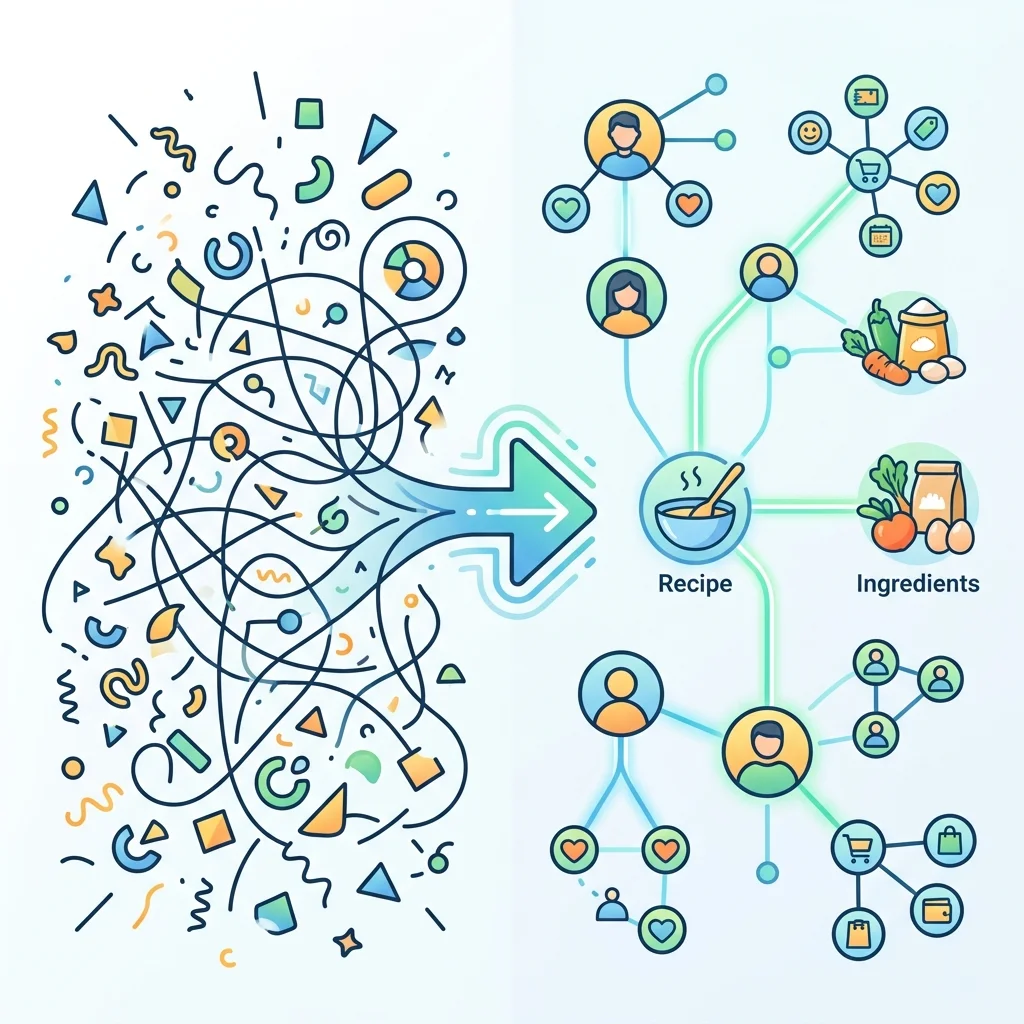
Another run might use needs, contains, or made with. Quantities may become nodes in one response and properties in another. Pancake, pancakes, and pancake recipe may become separate entities.
The result is syntactically graph-shaped but operationally weak. Queries cannot rely on stable labels, relationship types, or property names.
Rule of thumb: If two extraction runs can produce different graph topologies for the same fact, the downstream application—not the model—will inherit the ambiguity.
Strategy 1: Treat the schema as an extraction contract
Define the allowed entity types, relationship types, properties, and constraints before asking the model to extract anything.
The expected output becomes:
Structured-output features can constrain a model response to a supplied JSON Schema, and typed models such as Pydantic can represent the same contract in application code.56 Schema compliance, however, is not the same as factual correctness. A response can be perfectly valid JSON and still identify the wrong entity, relationship, or quantity.
A robust pipeline therefore separates four checks:
- Shape validation — Does the output conform to the schema?
- Semantic validation — Is this entity or relationship allowed in the domain?
- Evidence validation — Can the extracted fact be traced to source text?
- Identity resolution — Does this entity already exist under another name?
Strategy 2: Model processes, not only nouns
For simple lookup, a recipe-to-ingredient graph may be enough. For procedural questions, the graph needs a richer ontology:
That structure can answer questions such as:
- Which technique is applied to garlic?
- Which ingredients are used before the pan is deglazed?
- Which steps can run in parallel?
- What is the dependency chain leading to the final result?
The same principle applies to code graphs, workflows, and legal procedures. If sequence, dependency, scope, or causality matters, model it explicitly rather than hoping an LLM reconstructs it from nearby prose at query time.
Strategy 3: Normalize without destroying meaning
Normalization reduces accidental variation:
- Choose a canonical casing policy.
- Standardize units where conversion is safe.
- Normalize dates and identifiers.
- Maintain controlled vocabularies for relationship types.
- Preserve the original mention alongside the canonical value.
Do not normalize blindly. garlic, minced garlic, and garlic clove may refer to the same ingredient concept in one application but encode preparation state or quantity semantics in another. The correct merge policy depends on the questions the graph must answer.
Strategy 4: Resolve entities with multiple signals
Duplicate nodes fragment evidence. If MSFT, Microsoft, and Microsoft Corporation remain separate, their relationships and ranking signals are split across the graph.
Embeddings can help identify semantically similar candidates, but embedding similarity should usually be a candidate-generation signal, not an automatic merge decision. Similar names may describe different entities, while the same entity may have dissimilar aliases.
A safer entity-resolution pipeline combines:
- Deterministic identifiers where available.
- Exact normalization for casing, punctuation, and known aliases.
- Lexical or fuzzy matching for spelling variation.
- Embedding similarity to generate possible matches.
- Contextual checks using type, provenance, dates, and neighboring relationships.
- Thresholded merge, review, or create decisions based on confidence.
Knowledge graphs without entity resolution commonly accumulate duplicate nodes, reducing the clarity and utility of graph analytics.7 But false merges are often worse than missed merges: joining two different people, products, or code symbols can create paths that never existed.
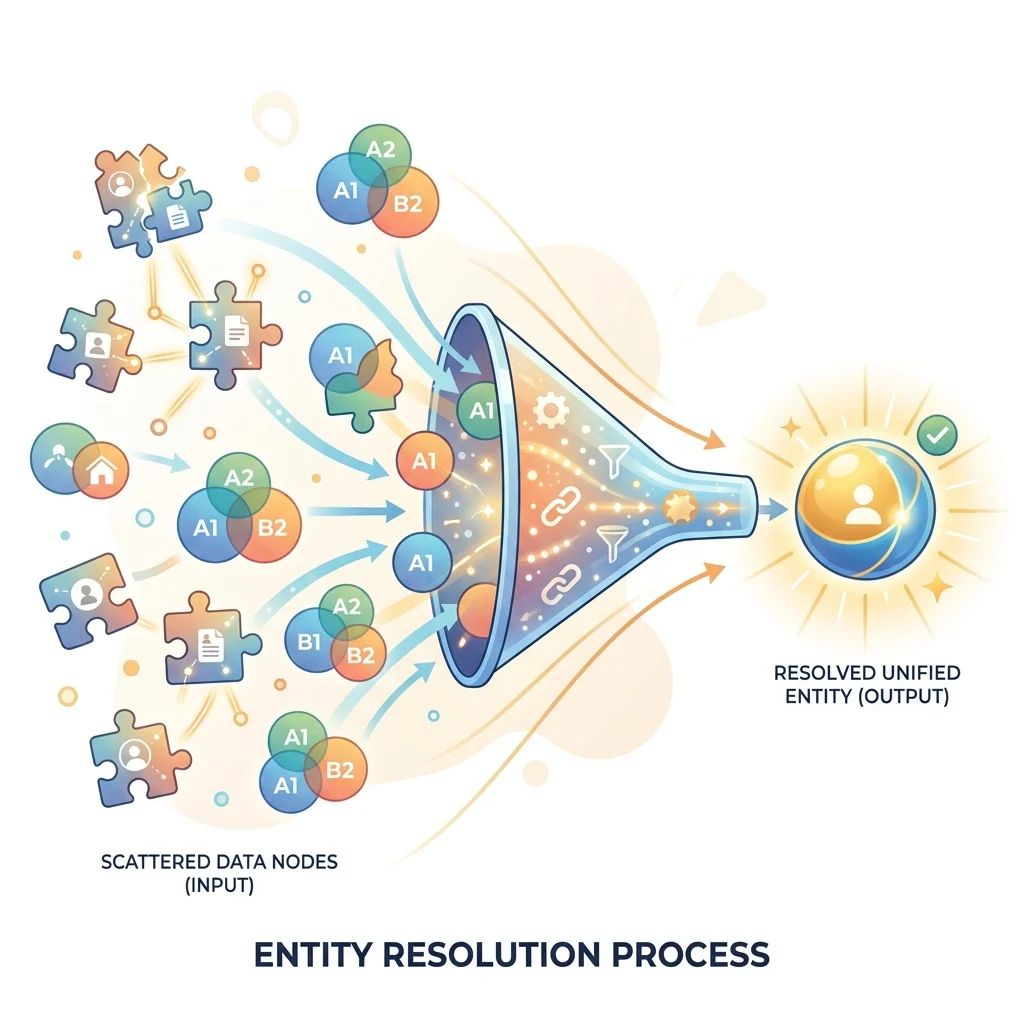
Always retain provenance: the source document, source span, extraction version, timestamp, and—where useful—confidence or review status. A graph used to ground an LLM should be able to explain where each asserted relationship came from.
3. Use Graph Algorithms for Graph-Shaped Questions
Once the graph is clean enough to trust, its topology becomes computationally useful. This is where graph-powered AI moves beyond decorative visualization.
Multi-hop traversal: express the path directly
Consider a simple query: find recipes that require garlic.
The advantage over SQL is not that relational databases cannot represent or traverse relationships. They can, using joins, recursive common table expressions, graph extensions, or precomputed structures. Nor is every graph query automatically faster.
The real advantage appears when relationships are numerous, variable in depth, and central to the workload. Property-graph query languages let developers express path patterns directly, while native graph engines can follow stored adjacency rather than repeatedly reconstructing connections through joins. Performance still depends on cardinality, indexing, path constraints, data distribution, storage design, and the query planner.
Use a graph because the workload is connection-heavy—not because a one-hop query looks shorter in Cypher.
Personalized PageRank: relevance through connectivity
Standard PageRank estimates global importance from link structure. Personalized PageRank (PPR) biases that process toward one or more seed nodes. Formally, it measures proximity or importance relative to the chosen starting distribution, commonly modeled as a random walk that follows edges but restarts according to a personalization vector with some probability.8
That is more precise than imagining a walker that returns only after a fixed number of hops. Restart can occur at each step, and practical implementations may compute or approximate the resulting stationary distribution in different ways.
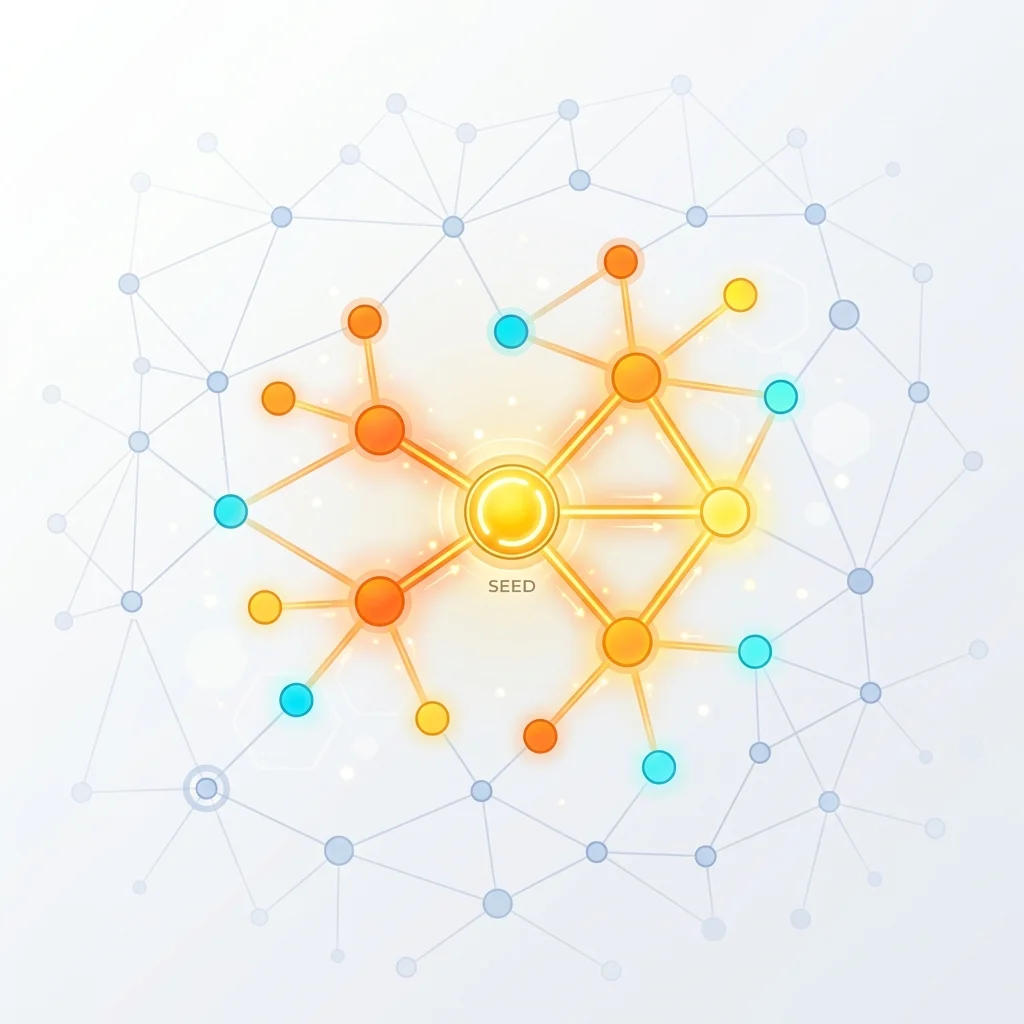
This is useful when relevance is relational. An item may not be textually similar to the query, yet still be strongly connected through shared entities, citations, dependencies, or user behavior.
HippoRAG is a research example. It combines LLM extraction, a knowledge graph, synonymy links, and PPR for multi-hop retrieval. Its NeurIPS 2024 paper reports improvements on the evaluated multi-hop question-answering benchmarks and lower online cost and latency than the iterative retrieval baseline used in those experiments.3 Those are benchmark results for that architecture and evaluation setup—not a universal guarantee that PPR will outperform vector retrieval on every corpus.
Pinterest’s Pixie offers a different proof point for graph-based ranking. The published system used random walks over a multi-billion-node object graph to generate real-time recommendations.4 Pixie demonstrates the scalability of graph-based recommendation, but it should not be described as an LLM memory architecture or as evidence for a specific GraphRAG design.
Shortest paths: retrieve the bridge, not just the endpoints
Vector search is good at finding semantically similar items. It does not inherently expose the explicit chain connecting two entities.
Suppose a developer asks:
Why did checkout fail after I changed
BasketConstructor?
If a code graph represents symbols and relationships such as CALLS, DEPENDS_ON, OVERRIDES, and READS, a path query can retrieve a compact chain:
The application can then provide the path, relevant source snippets, and edge evidence to the LLM. This does not prove causality; it narrows the search space to a structurally plausible explanation.
Useful variants include:
- Shortest path for the minimum-hop connection.
- Weighted shortest path when edges represent latency, risk, cost, or confidence.
- K-shortest paths when several plausible explanations should be compared.
- Constrained paths that must include or avoid particular node or relationship types.
Be careful with the word shortest. The fewest edges may not be the most informative path. A heavily used utility function can create misleading shortcuts. Weighting, type constraints, temporal filtering, and provenance often matter more than hop count alone.
The source presentation reports one internal evaluation on a .NET codebase in which graph-assisted context retrieval—including techniques such as path search—reduced code-search tool calls by 40%. Treat that number as a presenter-reported result from a particular implementation, not as a published benchmark or a general performance promise. The defensible architectural lesson is that deterministic subgraph retrieval can reduce exploratory LLM calls when the graph accurately represents the code and the task can be expressed as a path query. Measure the effect against your own baseline.
Subgraph matching: search for a shape
Sometimes the target is not a named entity. It is a topology.
A simplified Decorator-like structure might be represented as:

This query does not ignore data values completely; labels, relationship types, properties, and constraints still define the pattern. What changes is the retrieval target: the system is matching structure rather than relying only on text similarity or a known node ID.
Structural matching can support:
- finding recurring architecture patterns in code, such as a cached service wrapping another implementation of the same interface;
- detecting suspicious motifs in transaction networks;
- identifying dependency, security, or design anti-patterns;
- locating analogous citation or argument structures in legal corpora;
- discovering repeated workflow shapes.
This is not merely a faster way to perform a familiar text lookup. It is an enabling capability: the application can search for a shape even when it does not know the relevant entity names, symbol IDs, or vocabulary in advance.
Legal citation networks are a credible example of why structure matters. Research on US Supreme Court citations has found that network dependencies—including transitivity and popularity—are important alongside case characteristics.9 That supports analyzing precedent as a network. It does not, by itself, verify the stronger claim that a structural query can identify Miranda v. Arizona purely from citation shape, so that specific assertion should be treated as an illustrative hypothesis unless backed by a direct study.
4. Design Retrieval as a Portfolio
Graph retrieval is not a universal replacement for vector search. Different questions call for different retrieval operators.
| Question shape | Natural first operator | Why |
|---|---|---|
| “Find passages similar to this description” | Vector search | Semantic similarity is the target. |
| “What facts mention this entity?” | Entity lookup plus source retrieval | Identity and provenance matter. |
| “How are A and B connected?” | Path search | Intermediate relationships are the answer. |
| “What is most relevant around these concepts?” | PPR or another graph-ranking method | Connectivity relative to seeds matters. |
| “Where does this structural pattern occur?” | Subgraph or pattern matching | Topology is the target. |
| “What themes dominate the entire corpus?” | Community-based or global retrieval | The question requires corpus-level synthesis. |
A practical query pipeline can route among these methods:
- Parse the user’s intent and identify candidate entities.
- Decide whether the question is similarity-, entity-, path-, ranking-, pattern-, or corpus-oriented.
- Execute one or more retrievers.
- Collect source evidence, not only graph facts.
- Rerank and compress the results for the model’s context window.
- Generate an answer with citations or provenance.
Hybrid does not mean “run every retriever every time.” It means choosing and combining operators according to the query.
5. The Failure Modes to Expect
Graph-powered AI systems introduce their own failure modes:
- Extraction errors create false edges. A graph can make an incorrect relationship look authoritative.
- Entity resolution can under-merge or over-merge. Both fragment and distort retrieval.
- Ontology drift breaks query assumptions. New relationship types and naming conventions accumulate unless controlled.
- High-degree hubs dominate rankings. Generic entities can overwhelm PPR or path finding.
- Shortest paths create meaningless shortcuts. Edge weighting and type constraints are often necessary.
- Stale graphs return stale structure. Incremental updates, deletions, and temporal validity need explicit handling.
- Graph evidence may omit source nuance. Extracted triples should link back to the text that supports them.
- Dense connectivity can increase, not reduce, search complexity. Traversals need bounds, filters, and sensible query plans.
These are not reasons to avoid graphs. They are reasons to evaluate the graph as a retrieval system rather than as a visualization project.
Useful evaluation dimensions include:
- entity and relationship extraction precision and recall;
- entity-resolution accuracy;
- path validity and evidence coverage;
- retrieval recall at a fixed context budget;
- answer quality by query class;
- latency and index-update time;
- graph growth, duplicate rate, and orphan-node rate;
- the proportion of generated claims traceable to source evidence.
6. What This Article Deliberately Leaves at the Edge
The algorithms above cover three especially useful graph operations for AI applications:
- navigation — following paths and retrieving the intermediate context;
- ranking — estimating which nodes matter most relative to a starting point;
- pattern detection — finding a recurring structural shape.
They are not the complete graph-algorithm landscape. Other established families include:
- flow algorithms, which model movement through capacity-constrained networks;
- cost and routing algorithms, which optimize weighted paths;
- search algorithms, which systematically explore graph state spaces;
- dependency and network analyses, which expose critical nodes, bottlenecks, and connectivity.
There is also a second frontier where graph techniques increasingly overlap with machine learning:
- link prediction — estimating which relationships are likely to exist or appear next;
- node and graph similarity — finding entities or structures that resemble one another;
- clustering and community detection — identifying densely connected groups;
- dynamic graphs — representing relationships that change over time;
- schema-light or schema-less extraction — discovering structure when the ontology is incomplete or evolving.
Those areas can be highly relevant to GraphRAG and graph-based memory systems, but they bring different modeling and evaluation questions. They are acknowledged here to complete the map, not expanded into implementation guidance. The central subject remains the disciplined use of explicit graph structure and graph-native algorithms in AI retrieval systems.
7. Architectural Takeaways
The strongest graph-powered AI systems follow a few durable principles:
- Model the questions before modeling the graph. The query workload should shape the ontology.
- Constrain extraction. A schema is a contract, not a suggestion.
- Separate schema validity from factual validity. Structured output prevents malformed data, not incorrect facts.
- Resolve identity with multiple signals. Embeddings help find candidates; context determines whether to merge.
- Keep provenance attached. Every important node and relationship should remain traceable to evidence.
- Use graph algorithms where topology carries meaning. PPR, path search, and structural matching solve different problems.
- Retain vectors and source text. Similarity, structure, and evidence are complementary.
- Benchmark against simpler baselines. A graph earns its place only when it improves the target workload enough to justify its complexity.
Conclusion
The interesting future of graph-powered AI is not a graph database replacing every relational system, nor GraphRAG replacing every vector index. It is a more disciplined retrieval architecture in which each component does the work it is naturally suited to do.
LLMs can turn language into candidate structure. Schemas make that structure predictable. Entity resolution makes it coherent. Graph algorithms expose paths, proximity, and recurring shapes. Vector search recovers semantic neighbors. Source text preserves nuance and evidence. The LLM then synthesizes the result.
That combination is far more useful than a beautiful graph visualization—and much harder to build well.
The graph is not the intelligence. The intelligence comes from choosing the right structure, preserving its meaning, and applying the right algorithm to the right question.
References
Footnotes
-
Microsoft GraphRAG documentation, “Welcome to GraphRAG”: https://microsoft.github.io/graphrag/ ↩
-
Microsoft GraphRAG documentation, “Query Engine Overview”: https://microsoft.github.io/graphrag/query/overview/ ↩
-
Jiménez Gutiérrez et al., “HippoRAG: Neurobiologically Inspired Long-Term Memory for Large Language Models,” NeurIPS 2024: https://arxiv.org/abs/2405.14831 ↩ ↩2
-
Eksombatchai et al., “Pixie: A System for Recommending 3+ Billion Items to 200+ Million Users in Real-Time,” WWW 2018: https://arxiv.org/abs/1711.07601 ↩ ↩2
-
OpenAI, “Structured model outputs”: https://developers.openai.com/api/docs/guides/structured-outputs ↩
-
Microsoft Learn, “How to use structured outputs with Azure OpenAI in Microsoft Foundry Models”: https://learn.microsoft.com/en-us/azure/foundry/openai/how-to/structured-outputs ↩
-
Neo4j, “Entity resolved knowledge graphs: A tutorial”: https://neo4j.com/blog/developer/entity-resolved-knowledge-graphs/ ↩
-
Yang et al., “Efficient Algorithms for Personalized PageRank Computation: A Survey,” IEEE TKDE: https://arxiv.org/abs/2403.05198 ↩
-
Schmid, Chen, and Desmarais, “Generative Dynamics of Supreme Court Citations: Analysis with a New Statistical Network Model,” Political Analysis: https://doi.org/10.1017/pan.2021.20 ↩
Read next
Related articles
Architecting Agentic Workflows: A Deep Dive into the Redesigned Copilot Studio Designer

Architecting Business Logic with SharePoint AI Skills: A Technical Deep Dive