Microsoft Build 2026: Quick Summary & Technical Deep Dive

Writer
For those of us architecting solutions at the intersection of infrastructure and artificial intelligence, the transition from experimental “vibe coding” to strict, structured agentic engineering has been the defining challenge of the last year. We’ve spent countless hours optimizing strict agents.md rules and balancing compute loads.
The latest wave of announcements from Microsoft Build 2026 fundamentally shifts how we build, deploy, and ground these agents. By bringing massive compute to the edge and introducing true OS-level agent sandboxing, the barrier between local development and enterprise deployment has just been obliterated.
Here is a quick, comprehensive summary and technical deep dive into every feature, tool, and framework announced to ensure no technical detail is left behind.
1. Hardware & Local AI Architecture
The introduction of the Surface RTX Spark Devbox redefines the Windows local development baseline. Dubbed the “desktop data center,” it is built on the next-generation Nvidia RTX Spark SOC unifying CPU, GPU, and AI capabilities.
- Specs: Delivers 1 teraflop of AI compute, 20 CPU cores, and 128 GB of unified memory.
- Local Inference: Capable of running a 1-trillion parameter model entirely locally. During live demonstrations, we saw the GPU happily consuming ~90GB of RAM without breaking a sweat.
We also saw hints at the future with Project Solara, introducing new hardware form factors designed for the agent era:
- Stationary Device: Desk-based, MediaTek silicon, Windows Hello for Business sign-in, and Windows 365 cloud PC handoff.
- Portable Device: Qualcomm silicon digital badge, wearable, fingerprint unlock, and camera-equipped for on-the-go agent tasks (e.g., capturing and cleaning up photos).
2. Windows ML, AI Models, & Local Frameworks
To power these local agentic loops with zero cloud latency, Microsoft unveiled new models optimized for local execution and the new MAI Model Family (7 New Models):
- ion instruct: A new, highly efficient local reasoning Small Language Model (SLM).
- ion plan: A local planning model that drives a full local agentic loop with tool access.
- MAI Image 2.5 & Flash variant: #2 on the image editing leaderboard (surpassing Nano Banana 2).
- MAI Transcribe 1.5: State-of-the-art (SOTA) accuracy across 43 languages; 5x faster than rival models.
- MAI Voice 2: Speech generation available in 15 languages.
- MAI Thinking 1: First premier reasoning model (scoring 97% on AIME 2025, 53% on SWE-bench Pro).
- MAI Code 1 Flash: 5 billion parameters, scoring 51% on SWE-bench Pro, rolling out directly in VS Code for incredible performance in a highly efficient footprint.
- Healthcare Frontier Model: Developed in partnership with Mayo Clinic.
3. Developer Experience (OS & CLI)
Microsoft is finally providing a first-class, distraction-free environment that speaks fluently to developers regardless of their background, drastically reducing context switching.
- OS UI & QoL: Vertical taskbar (Insider builds), PowerToys “Grab and Move” (Alt+Drag windows anywhere), and “End Task” bypassing Task Manager.
- Git-Aware File Explorer: Natively shows branch names, last change author, commit messages, and file statuses.
- Microsoft Edit: The default Windows editor has been updated with native syntax highlighting.
- Intelligent Terminal: Features a built-in GitHub Copilot with an “agent pane” that detects errors in real-time and suggests inline fixes (like regex corrections).
- Native Linux/Mac Parity: Grep, curl, tar, sudo, and 75+ CLI utilities (mv, head, tail, touch) are now native to Windows. Out-of-the-box support for Starship, Zsh, and Homebrew.
- WSL Containers: First-class, native container support on Windows leveraging GPU acceleration and referencing existing container files (e.g., Dockerfiles).
Tip: When setting up your Python environments for these new agentic loops, pairing these native tools with strict package management via
uvwill be the standard out-of-the-box experience.
4. Azure Cloud & Infrastructure
On the backend, data architecture and compute get massive boosts for scaling heavy read/write agentic workloads.
- Maia 200 AI Accelerators: Live in Iowa/Arizona, delivering 30% improved tokens-per-dollar. Validated with GPT-55 and powering M365 Copilot.
- Cobalt 200 VMs: Next-gen ARM-based CPU delivering 50%+ better performance for cloud-native apps and 33% lower latency / 23% higher throughput for agent workloads.
- Horizon DB: A fully managed PostgreSQL service on Azure. Designed for high availability, zone-redundant, automated failover, 128TB storage per cluster, up to 15 read replicas, and crucially features a 7x performance gain via Fabric GPU acceleration.
5. Microsoft IQ & Agent Grounding (Foundry)
A multi-agent system is only as good as the data it can reason over. Microsoft Foundry introduces a three-tiered grounding mechanism—Microsoft IQ—to give agents a continuous, live understanding of the organization without relying on stale vector uploads:
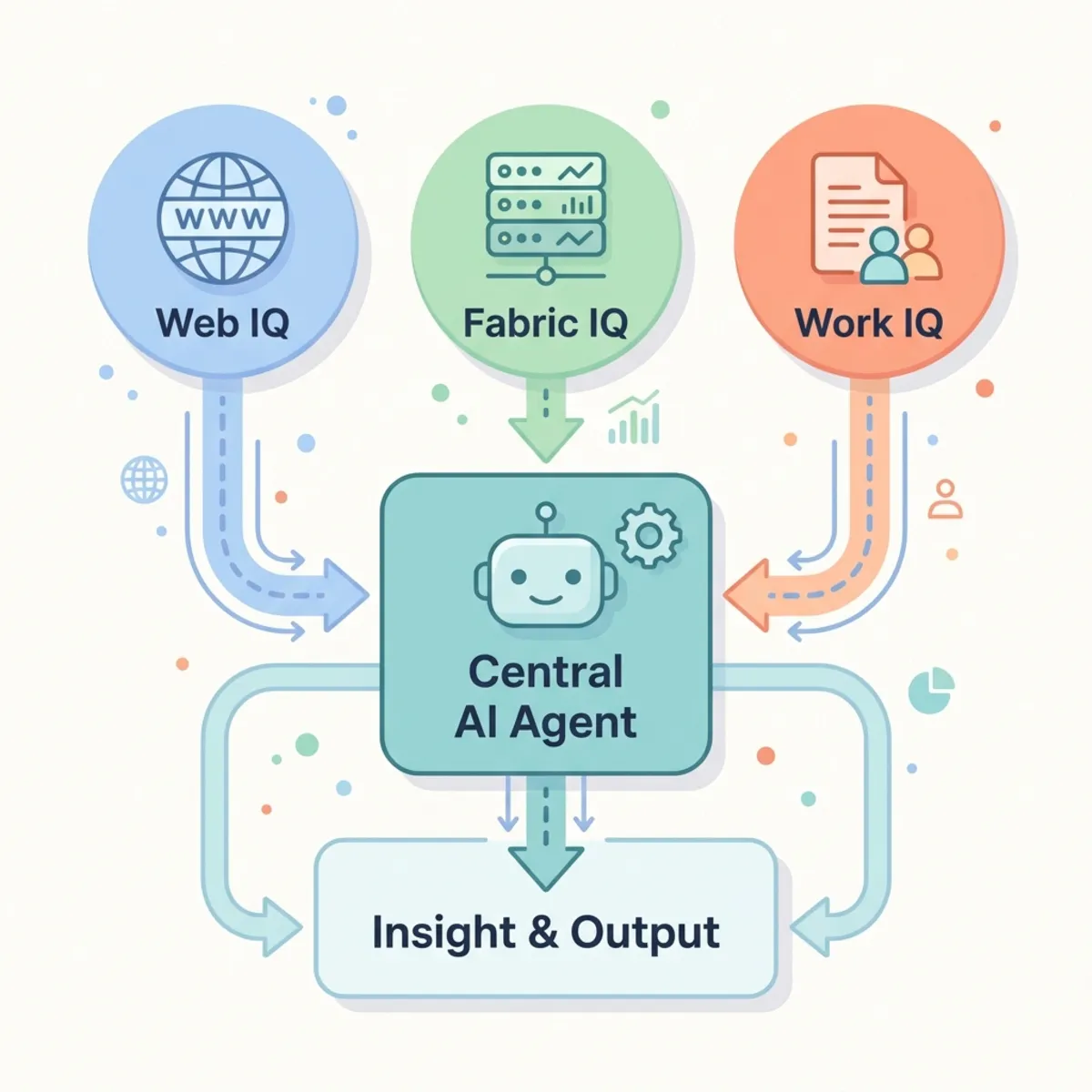
- Web IQ: Grounds agents in fast, verifiable external internet content (news, images, video).
- Fabric IQ: Grounds agents in live operational data and telemetry via a fabric ontology (effectively a live ontology of your infrastructure).
- Work IQ: Grounds agents in enterprise procedures and people (e.g., direct integration with living documents like active SharePoint playbooks).
6. Security, Sandboxing, & Agent Frameworks
As we hand over CLI access to agents, security becomes the immediate architectural hurdle. Microsoft addresses this natively:
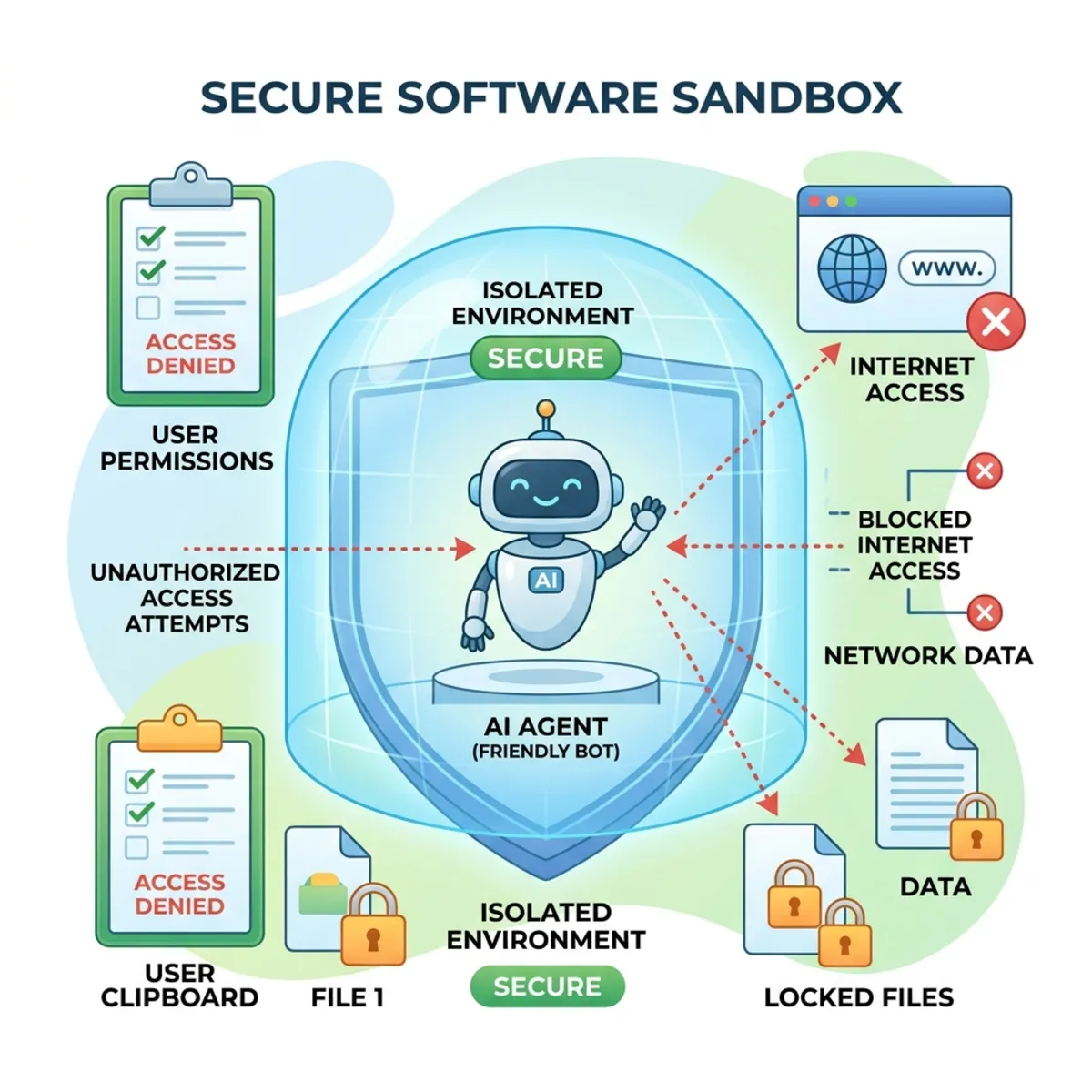
- Microsoft Execution Containers (MXC): Applies OS-native process isolation policies for securing AI tool calls.
- OpenClaw Windows Companion App: A native WinUI3 app utilizing MXC to sandbox agents. It allows you to run Bring-Your-Own-Copilot (BYOC) sessions and features highly granular folder permissions (read-only, write, hidden) while limiting clipboard/internet access.
Live Test Note: An agent instructed to aggressively delete desktop files was completely stonewalled by MXC’s read-only policies, failing safely in the background.
- GitHub Copilot App: A dedicated app for managing agentic coding sessions. Uses Git worktrees to isolate parallel sessions preventing agents from stepping on each other’s toes. Features “Agent Merge” (babysits PRs through CI and merge conflicts), “Pick and Polish” custom canvas UI generation, and interactive mini-games (Mona).
- Raffen Up: A single command to instantly deploy containerized apps with database backends directly to Microsoft Fabric.
7. The Enterprise Rollout: Autopilots
With the Agent 365 SDK reaching General Availability (GA), the pipeline for building custom agents is fully realized, expanded to support local agents on Windows and OpenClaw.
For enterprise operations, the introduction of Autopilots represents the maturity of the Microsoft Agent Framework.
- Unlike session-based bots, Autopilots are enterprise-grade, autonomous, long-running agents that operate securely within your tenant. For architects building custom logic in Copilot Studio, Autopilots offer a compliant, natively integrated evolution of those workflows.
- Scout: The flagship Autopilot, capable of autonomously handling Teams group chats and managing Outlook threads independently.
8. Quantum Computing
Finally, the hardware horizon continues to expand with Myana 2, a next-generation material stack that pushes quantum computing closer to viability, delivering a qubit mean lifetime of 20 seconds to 1 minute—a staggering 1,000x improvement over its predecessor.
Conclusion
The tools for true autonomous engineering are no longer in preview; they are here, running locally, and fully sandboxed. From the unified memory of the RTX Spark Devbox to the secure isolation of MXC and the enterprise scale of Horizon DB and Autopilots, the barrier between local development and autonomous deployment has been removed. It’s time to build.
Read next